 Companion Compass

Candy AI review: free limits, costs and account controls
Candy AI review covering 5 free messages, paid token grants, renewal charges, EverAI billing and account privacy for Canadian adults.
- Price / month$13.99/mo as displayed; currency depends on your region
- NSFWyes · images yes
- Age checkself declaration
- PlatformsWeb
In this article
- Criterion scores
- Price and policy dates
- What it looks like
- Understand the charge before comparing prices
- What the published features actually distinguish
- Adult policy and fictional-character boundaries
- Who handles the conversations and how long records remain
- Age checks and the account you are evaluating
- EverAI charges, renewal and leaving the subscription
- Purchase details that deserve attention
- Compare the allowance and account model
- Where the account model fits
18+ only. This Candy AI review covers billing, privacy and ordinary conversation with fictional adult characters.
Candy's free introduction is small: 5 messages across characters, 1 created character and 1 generated image. Paid Standard adds 100 tokens a month, and Premium Plus includes 330. The subscription and any extra token purchases are therefore two separate parts of what you spend. A short free exchange shows you the interface, but it tells you little about whether a character stays consistent over an ongoing story.
The details that matter most sit outside the character screen. The introductory monthly amount goes up at renewal. The public dollar symbol doesn't confirm a Canadian currency quote. And the privacy policy allows training and possible human review of de-identified interactions. Candy suits a reader who is willing to try a limited introduction and set a separate token budget. It is a harder choice if you want a free allowance that refills, a settled Canadian total, or conversations treated as confidential records.
Criterion scores
Provisional (7/8 criteria). Scores are computed from each app's published terms, pricing, policies and store listings on the dates shown. We have not yet run paid test accounts; when we do, experience criteria will be added and the cap on the total score removed. Affiliate links never change a score. A score marked Full data rests on all eight criteria. Provisional means five to seven criteria could be scored from published facts. Limited data means only three or four criteria could be scored; such totals are capped at 3.5 and should be read as a floor, not a verdict. Apps with fewer than three scorable criteria get no total. Totals are weighted means of the scored criteria only and move when missing facts get documented. Full methodology
| Criterion | Score /5 | Basis |
|---|---|---|
| Pricing transparency | 2.0 | billing descriptor published; intro price differs from renewal |
| Free tier | 2.0 | 5 messages in total, no daily renewal |
| Cancellation and refunds | 4.0 | cancellation steps documented; access after cancellation stated; refund policy published; renewal/auto-renew caveat in red flags |
| Content rules | 5.0 | public content rules; rules ban minors and real-person likeness; adult content opt-in or stated 18+ gate |
| Privacy | 4.5 | policy URL; policy dated 2026-10-19; deletion path documented; retention stated; operator in Malta; chats used for training per policy |
| Age check | 3.0 | self-declaration with stated enforcement/local checks |
| Platforms and language | 3.5 | web, PWA, English |
| Reputation | n/a | no public rating |
Price and policy dates
Edited 2026-10-29. The plan and help-page details, including the 5-message free allowance and the 100-token Standard grant, were checked on 2026-10-28. The privacy policy is dated 2026-10-19. Promotional prices, account screens and terms can change, so go by the selected plan and the renewal confirmation when you make a new purchase.
What it looks like
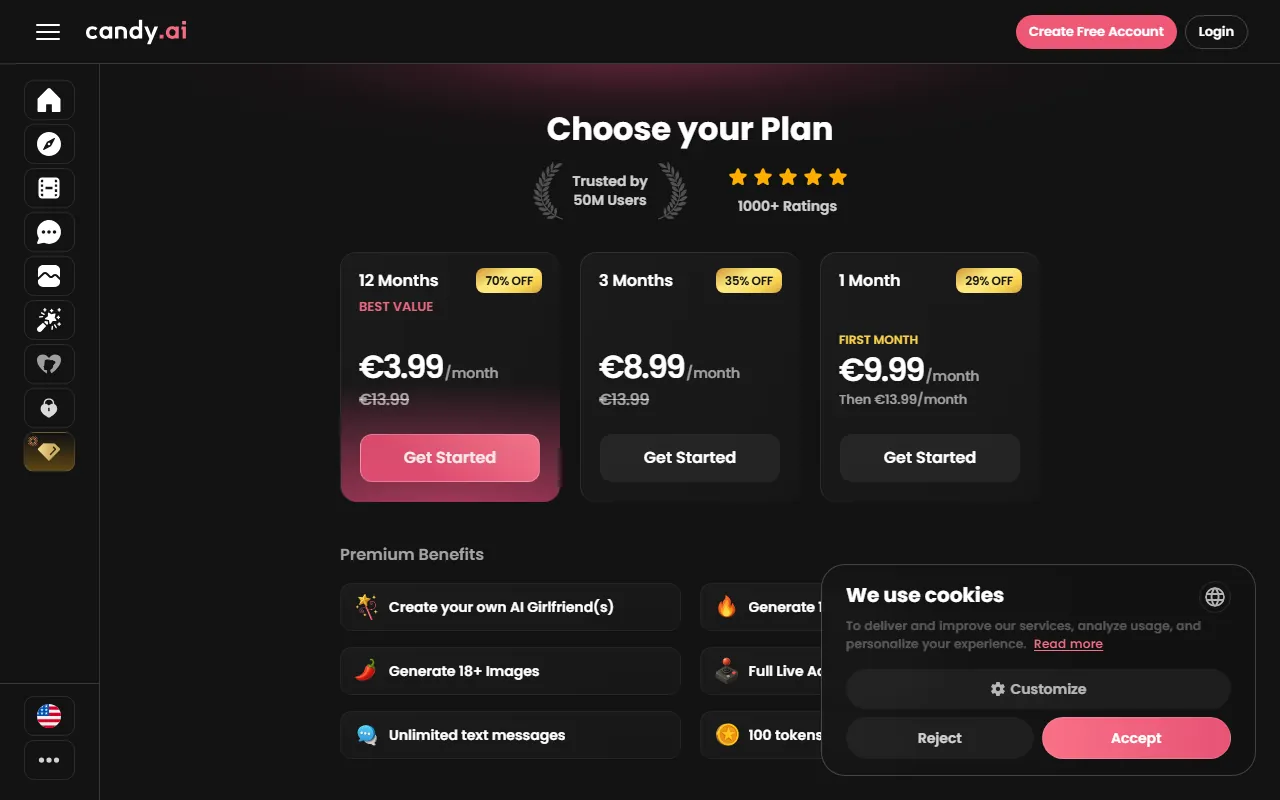
Screenshots of the official pages, captured on the dates shown.
Understand the charge before comparing prices
Candy's public offer shows $9.99 for the first monthly term and $13.99 on renewal. The quarterly option charges $26.97 for three months and lists an $8.99 monthly equivalent. The annual option charges $47.88 for the year and advertises $3.99 per month as an equivalent. These are the page's original figures with a dollar symbol. The displays don't state a currency code or how Canadian provincial tax applies.
So the price comparison starts with how long you commit. A yearly headline spreads one upfront charge across twelve months for comparison; it doesn't turn that payment into monthly instalments. In the same way, the promotional first month is a different amount from the ongoing monthly rate. Write down the full amount, term and next renewal shown for the offer you pick. A Canadian buyer should also check the currency code and the GST/HST treatment on the payment summary.
Tokens are a separate cost. Standard's 100 monthly tokens and Plus's 330 are the included allowance, and buying more raises what you spend. The allowance on its own can't tell you what a given month will cost. That depends on the actions you use, how many tokens each one consumes, any included access that applies, and the package you actually buy. Set a separate limit for extras instead of assuming the displayed subscription price caps what the account can charge.
Premium Plus also lists 20 memory slots, 5 chat clones and a 10% top-up bonus on quarterly or yearly plans. These are differences in features and allowances; they don't replace checking what the plan actually costs. Compare Plus with Standard only after deciding whether those tools help with the character conversations you normally have. More capacity is worth paying for only if you'll use it.
The payment help lists major credit cards, cryptocurrency, Apple Pay and Google Pay for subscriptions or token purchases, with availability varying by location. A wallet named on a help page tells you what might be offered, but the checkout on your own account decides which option applies to a given transaction. Record the purchase channel along with the plan name. That helps if you later need to tell a subscription charge apart from a token purchase or explain a billing problem to support.
| Offer or allowance | Displayed charge | Term or inclusion |
|---|---|---|
| Monthly introduction | $9.99, currency code unspecified | First month; renewal display $13.99 |
| Quarterly | $26.97, currency code unspecified | Three months upfront; $8.99 monthly equivalent |
| Yearly | $47.88, currency code unspecified | Year upfront; $3.99 monthly equivalent |
| Standard tokens | 100 tokens per month | |
| Premium Plus tokens | 330 tokens per month | |
| Free introduction | 5 messages total, 1 character, 1 image |
What the published features actually distinguish
The free introduction includes creating 1 character. That lets you see how an invented adult persona is set up before you think about a longer subscription. A character's description is creative background, so give it invented preferences and a fictional setting. You can set a consistent tone without handing the service your real address, workplace or private relationship history.
The paid help pages describe image and video features alongside conversation, and they spell out the monthly token grants: 100 on Standard and 330 on Plus. A token total is a unit of spending. It doesn't guarantee how many finished results you'll find usable. If you mainly care about written exchanges, look first at the conversation itself and the plan terms, and don't feel you have to use the media allowance just because it's included.
Premium Plus lists 20 memory slots and 5 chat clones. Slots are capacity for saved material; clones are separate versions of a chat. They may help you keep different fictional story directions apart, but the numbers don't tell you whether a character will remember a particular detail correctly. If an ongoing creative project matters to you, keep your own outline. It also makes it easier to leave the account without losing the original premise.
Candy runs as a web app and offers an Add to Home Screen option. That makes the site easy to open from a phone, but purchases still depend on the account's actual billing arrangement. A store app with a similar name, or a download advertised as a modified premium edition, is not evidence of what the official service offers. Confirm the product and operator before applying any subscription claims to it.
Adult policy and fictional-character boundaries
Candy uses an 18+ affirmation gate and says additional checks may apply where local rules require them. Its adult-content rules still limit what the service allows. This review covers ordinary conversation and account management. Use fictional adults and keep their backgrounds separate from real, identifiable people.
An adult label describes who can use the service and what it covers. It doesn't mean the subscription includes everything, and it isn't a privacy guarantee. The same spending and data questions apply whether you use a character for a casual chat or a continuing fictional story. Read the account rules as part of the purchase, and don't take a broad marketing description as permission for any request. A paid plan is still bound by those rules.
Who handles the conversations and how long records remain
The operator is EverAI Limited in Malta. Its privacy policy covers AI training and possible human review of de-identified interactions. De-identification is a processing step, and it's no reason to share more personal information than a fictional conversation needs. Marking an account or character as private doesn't, on its own, tell you which company systems or authorized reviewers may process what's in it.
Different categories of records have different retention periods. Account information is generally kept for up to 3 years after the last activity, and some circumstances can shorten that. Financial records are kept for 10 years. Marketing information is generally kept for no more than 2 years after the last interaction. Each period applies to different records and starts from a different trigger. If you only look at the account-deletion button, you'll miss the separate rules for transactions and other retained information.
The documented deletion path is My Profile, Settings, Danger Zone, Delete Account, then confirmation. Under the policy, erasure requests are handled without undue delay, subject to exceptions. That doesn't promise that every kind of record disappears immediately. Before you remove an account, keep any receipts and cancellation confirmation you might need later. Don't rely on stored character conversations as the only copy of your own creative notes.
In practice, the privacy decision comes down to what you share. A fictional adult persona can have a made-up job, hobbies and story setting without drawing on your own sensitive circumstances. If you'd be uncomfortable with a conversation being retained or reviewed under the published policy, leave those details out. However friendly or reassuring the service sounds, the operator's stated data practices stay the same.
Age checks and the account you are evaluating
The published age policy requires an 18+ affirmation and allows for additional local verification. That simple age statement doesn't mean every Canadian account goes through exactly the same verification route. An age gate also doesn't tell you which identity-check provider is used or how each account will be handled at signup.
For an adult trying the account, the first useful questions are what's being asked for and why. Keep account information separate from the fictional character's profile. The character can stay entirely invented even when the account needs truthful eligibility details. Treat the payment decision separately from the age acknowledgement too: confirming you're an adult says nothing about the billing period, token allowance or renewal terms.
The free offer gives 5 messages shared across characters. That's a clear limit for the introduction once you have access, with no promise of a premium trial or a daily allowance that resets. Read the account's current terms before choosing a subscription, especially if the interface shows a promotional first payment next to a longer commitment.
EverAI charges, renewal and leaving the subscription
The statement descriptor is EverAI. The name links a charge to the operator even if you know the character app as Candy. When checking a statement, compare it with the purchase receipt, amount and date. A matching descriptor helps, but the statement line alone won't tell you whether the charge was a subscription renewal or a separate token purchase.
Candy subscriptions renew automatically. The public monthly promotion goes from a displayed $9.99 first charge to $13.99 on renewal, shown with the same unspecified dollar symbol. A budget built on the first month alone would miss that increase. For a longer offer, keep the full term payment in view rather than treating the advertised monthly equivalent as your next charge.
To stop a recurring subscription, the documented route is My Profile, Settings and Unsubscribe, followed by the confirmation prompts. You keep access until the current paid period ends. Save the confirmation and check the displayed renewal status so you know it worked. Account deletion is a separate path under Danger Zone. Turn off the recurring payment directly, and don't assume that deleting an account means billing has stopped.
Asking for a refund is a separate step. The terms give a general request window of 24 hours, with restrictions tied to token use, and set out separate initial-purchase withdrawal provisions for EU or UK circumstances. Those provisions shouldn't be assumed to apply to a Canadian purchase. Cancelling stops the ongoing subscription; whether you can get money back depends on the applicable terms and the transaction. If you need account support, keep the receipt and a clear description of the billing problem.
Purchase details that deserve attention
The introductory and renewal prices are different. The public annual display of $47.88 is paid upfront for the term, and $3.99 is its monthly equivalent. Keep both distinctions in mind whenever a comparison quotes a low headline figure. They change both what you pay now and what you're committing to.
Extra tokens can also raise spending. The 100 monthly Standard tokens are an allowance, not a fixed total price for every way you might use the service. Set a separate limit for optional purchases, and don't read a larger token grant as proof that a higher tier suits your own conversation habits better.
When checked on October 28, 2026, the Trustpilot profile showed a removal notice. That means a historical score can't be treated as a current rating, but the notice doesn't say why the profile was removed. Reddit discussions include individual concerns about conversation consistency and billing. Those posts can suggest questions to ask, but they don't prove a general performance result or misconduct.
Retention is another practical trade-off. Candy's account-data period can run to 3 years after activity, and financial records follow separate rules. Decide what you're comfortable having stored before a character becomes familiar. The Canada buying guide adds local currency, payment and tax context for judging subscriptions.
Compare the allowance and account model
The closest alternatives differ mainly in how free access works. Nomi publishes 50 daily messages. Secrets publishes 20 daily general messages plus a separate total of 100 messages for custom characters. Candy's 5 messages are a one-time introduction shared across characters. Replika includes free avatar chat, though these published details give no daily number.
Prices also have to be compared through the right channel. Nomi's CA$129.99 Standard Yearly and Replika's CA$114.99 Annual ULTRA are named Canadian App Store items. They aren't equivalent tiers, and they shouldn't stand in for a web checkout price. The Candy alternatives comparison sets out the practical differences, and the AI girlfriend app guide covers the wider range of character formats.
The exit controls differ too. Replika lets users remove saved memory items one by one, but removing the full conversation history requires deleting the account. Nomi says it removes personal information in about 28 days after account deletion, subject to exceptions, and states that its chats are not end-to-end encrypted. Secrets keeps chats after the paid term ends and the account goes back to free access. Each product handles ongoing conversation records its own way. Compare the specific action you want, such as stopping payments, clearing a history or keeping a fictional story while downgrading, and don't assume every delete control does the same thing.
| Product | Free access or quota | A relevant paid distinction |
|---|---|---|
| Candy AI | 5 messages total across characters | 100 Standard tokens or 330 Plus tokens monthly |
| Nomi | 50 messages per day | Standard supports up to 10 companions |
| Replika | Chat and avatar customization | Pro adds voice calls; Ultra adds memory tools |
| Secrets AI | 20 general messages/day; 100 custom messages total | Premium includes 8,000 Moments monthly |
Where the account model fits
Candy is easiest to judge as a short introduction followed by a separate decision about subscribing. The 5 free messages can show you the basic presentation and whether a character's style appeals to you. If you're fine with a small preview and an optional token budget, those terms may be manageable. If you need a long free conversation that keeps refilling, you're looking for something else.
Plus's 20 memory slots and 5 chat clones matter if you want to keep several fictional directions organized. They aren't, by themselves, a reason to buy the higher tier. If a fixed Canadian total is your priority, first pin down the currency, tax and renewal amount for the offer you've chosen. If confidentiality is central to the conversations you want, weigh the policy's training and review terms before sharing personal material.
You can also decide to use it only occasionally. The small introduction doesn't commit you to a bigger package, and a subscription doesn't require you to use every included feature. If you'd mostly send a short message now and then, compare that habit with the 100-token Standard grant and the actual recurring charge. If running several story variations is the main draw, the named Plus tools deserve a closer look. Start with what you want to do, then pick the plan.
What we like
- The small introduction suits a reader mainly checking the interface and character format.
- Separate feature allowances make it possible to budget deliberately.
What could be better
- The published free messages don't support a daily chat routine.
- An unclear dollar headline can't settle a Canadian monthly budget.
Frequently asked questions
What is Candy AI?
Candy is a web-based fictional-character service run by EverAI Limited in Malta. Its free introduction includes 5 chat messages, 1 created character and 1 generated image. Paid plans add feature access and monthly tokens. Think of the account as a conversation interface with specific spending and data terms. It isn't a human relationship, and it doesn't promise consistent judgement.
Is Candy AI free every day?
The published allowance is 5 messages shared across characters, and no daily renewal is stated. The same help page includes 1 character and 1 image. It's a limited introduction. Paid Standard separately includes 100 tokens per month, so don't confuse the free message allowance with the recurring paid token grant.
Does Candy offer a week of Premium without payment?
The documented free offer is an allowance of 5 messages, not a Premium trial of any published length. Some review pages mention recurring free messages or a week-long trial, but the official help for free users gives the smaller allowance. Check the current subscription screen before treating a promotional label as a time-limited paid-plan entitlement.
Are the displayed prices Canadian dollars?
The public page uses a dollar symbol without stating the currency code. Its annual display is $47.88 upfront and $3.99 as a monthly equivalent, and those figures should be read in that context. For a Canadian purchase, the payment summary needs to show the actual currency, the provincial tax that applies and the full renewal amount.
What is the difference between Premium and Premium Plus?
The published monthly token amounts are 100 for Standard and 330 for Plus. Plus also lists 20 memory slots and 5 chat clones, with a 10% top-up bonus on quarterly or yearly plans. Weigh the selected plan's price against the features you expect to use; a bigger allowance doesn't automatically mean better value for every account.
Why does EverAI appear on my statement?
EverAI is Candy's stated billing descriptor. Match the amount and date with your account receipt to identify the transaction. The public monthly offer starts at a displayed $9.99 and renews at $13.99, and tokens can lead to additional purchases. Recognizing the operator's name doesn't replace checking which transaction the statement entry is for.
Can I remove my account information?
Candy documents a Delete Account control under My Profile, Settings and Danger Zone. Its privacy policy still treats account retention, generally up to 3 years after activity, separately from financial records, which are kept for 10 years, and other exceptions. Use the deletion process for the account and keep any billing records you might need afterward.
How should I interpret Candy AI reviews on Reddit?
Treat individual posts as experiences to check against the current plan, platform and date. Complaints about extra spending are worth comparing with Standard's 100 monthly tokens and any separate purchases. An anecdote can point to a useful question, but it isn't a measured quality score or a conclusion about every subscriber.
Is Candy an ordinary downloadable phone app?
The official service is a web app with an Add to Home Screen option. That puts the website in a handy spot on your phone, but it doesn't create a separate native-store subscription. Candy's 5-message introduction is part of its published account offer and shouldn't be credited to an unrelated app just because its name looks like Candy. Check the operator and product before applying pricing or feature claims to a download.
What can I learn from the first few messages?
The 5-message introduction can show the basic layout and a character's initial tone. It says little about a long story, extensive memory or how dialogue changes over time. The separate allowance of 1 created character also lets you look at the setup format. Keep your conclusions in line with how limited the introduction is, and pick a paid feature only when it serves something specific you want to do.